Three OpenGov Lab papers accepted at AIOG 2026
Three papers from the OpenGov Lab have been accepted at the AI & Open Government Workshop (AIOG 2026), co-located with ICAIL 2026 in Singapore on 8 June.
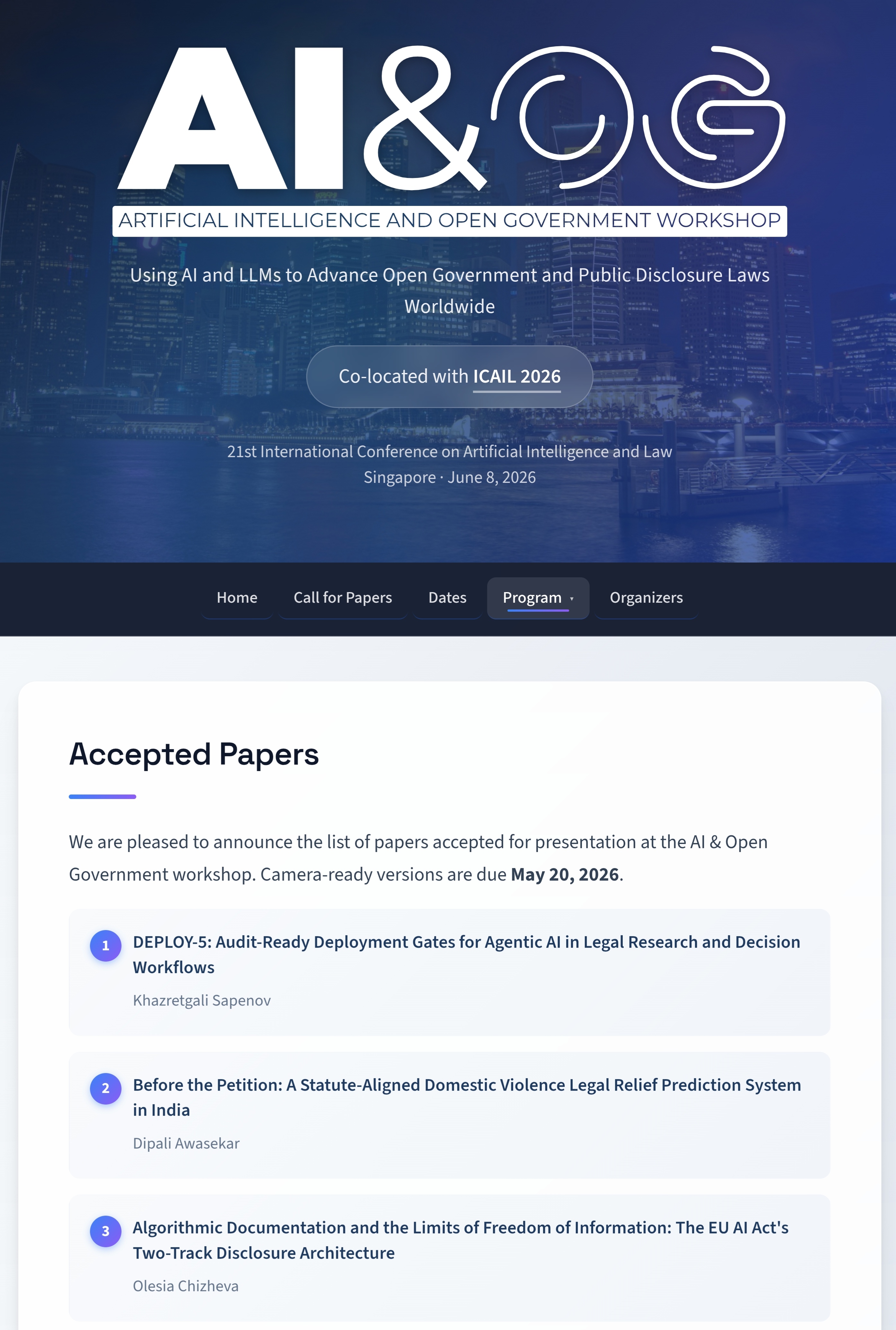
The accepted papers cover different facets of automating and improving open government data and FOIA processes:
From Formal Transparency to Practical Interpretability: WOOLens for Open Government Data
Yelyzaveta Terentieva, Joris Wechsler, Cynthia de Vries, Teun Jans, Jaap Kamps
Resulting from an ERP project in the MSc Cultural Data & AI programme, this paper presents WOOLens — a framework for making open government data not only formally accessible but practically interpretable. Disclosed documents often technically comply with transparency law but remain difficult to navigate in practice. WOOLens addresses this gap with an approach focused on coherence, usability, and metadata enrichment.
Out of the Box: Zero-Shot Vision-Language Models for Redaction Detection and Page-Stream Segmentation
Özgür Ateş, David Graus
Resulting from Özgür's BSc AI individual project, this paper investigates whether off-the-shelf vision-language models — without any task-specific training — can detect redactions in disclosed government documents and segment page-streams. The findings suggest zero-shot VLMs perform well enough to be practically useful, lowering the barrier for practitioners without resources to train custom models.
To Redact, or not to Redact? A Local LLM Approach to Deliberative Process Privilege Classification
Maik Larooij, David Graus
Deliberative process privilege is one of the trickier FOIA exemption categories — exemption depends on context the classifier needs to reason about, not just surface features. This paper shows that a locally hosted LLM can classify deliberative process material with reasonable accuracy, without sending sensitive government data to commercial LLM APIs.
About AIOG
AIOG is a first-edition workshop bringing together researchers and practitioners across information retrieval, legal AI, NLP, e-discovery, and open government practice — communities that share concrete problems but rarely meet under one roof. The workshop is co-organised by David Graus (OpenGov Lab) with Graham McDonald (University of Glasgow) and Jason R. Baron (University of Maryland).
The full list of accepted papers is at aiog.net/accepted-papers. Camera-ready versions are due 20 May, and papers will be available on OpenReview shortly after.
Congratulations to the authors — we look forward to seeing this work presented in Singapore in June!